Every year, approximately 20 divers lose their lives in cave diving accidents. According to the International Underwater Cave Rescue and Recovery (IUCRR) database, the vast majority of these fatalities are preventable through proper training and strict adherence to established safety protocols. In 2019, the diving community mourned the loss of experienced diver Josh Bratchley, one of the Thai cave rescue divers, who died during a cave diving incident in Tennessee—a stark reminder that even skilled divers face extreme risks when protocols break down.
Deep cave diving presents hazards that simply don’t exist in open water diving: complete darkness, narrow passages, silt-outs causing instant zero visibility, the inability to surface directly in emergencies, and nitrogen narcosis at depth. Many experienced open water divers—even those with hundreds of logged dives—dangerously underestimate these unique threats. Whether you’re navigating with a standard dive mask or a custom dive mask with prescription lenses, the underwater environment demands flawless execution of safety protocols.
This guide provides the critical safety protocols that separate fatal mistakes from successful deep cave diving expeditions. Drawing from expert experiences and accident analysis reports from the Divers Alert Network (DAN), you’ll discover the non-negotiable principles that keep cave divers alive.
Protocol 1: Understanding the Overhead Environment
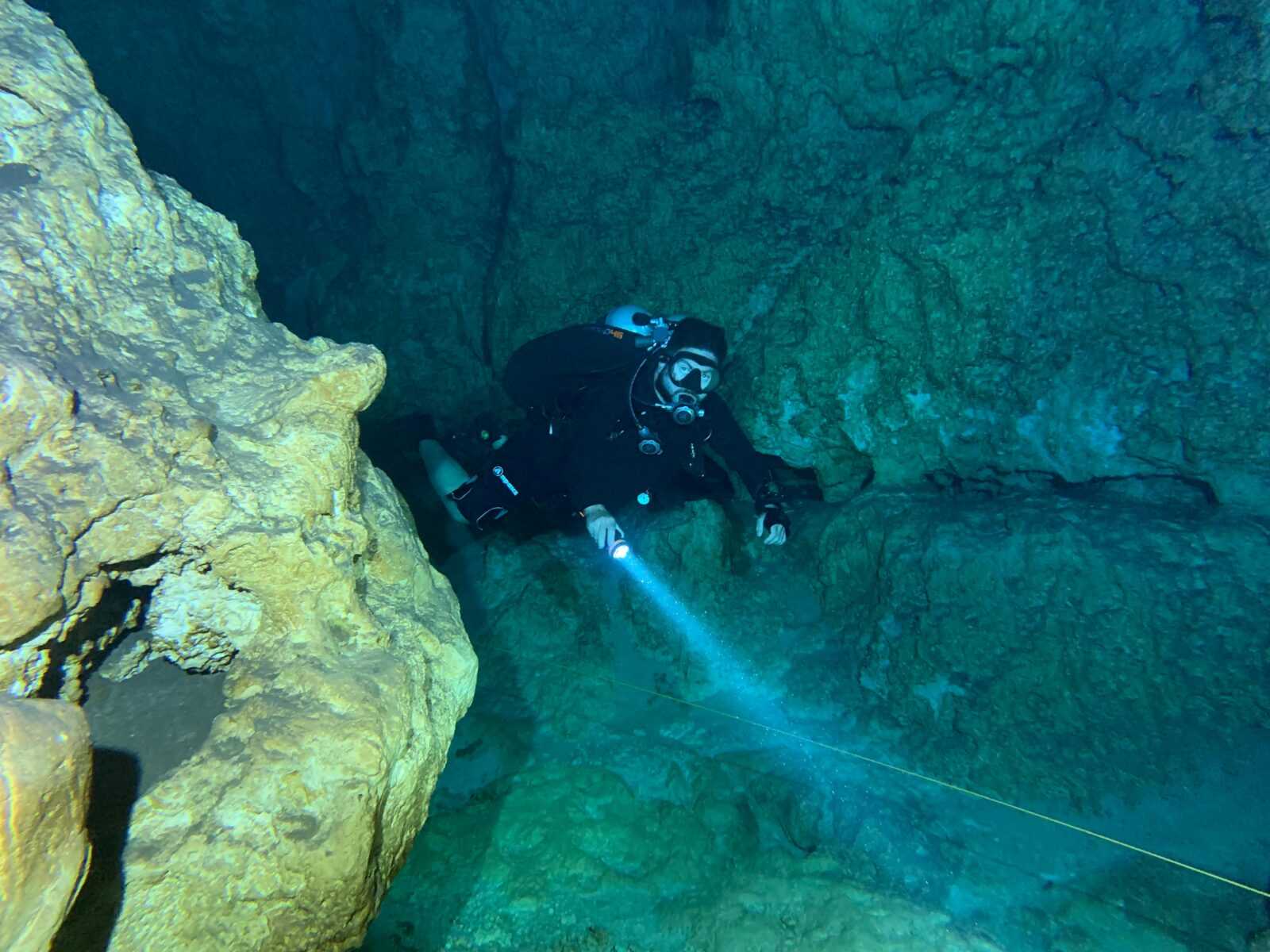
Before entering a cave, you must fundamentally understand why cave diving kills even experienced divers. In open water diving, virtually every problem has one solution: ascend to the surface. Cave diving eliminates this option. Between you and the surface lies hundreds or thousands of feet of rock, narrow passages, and complete darkness.
The psychological impact cannot be overstated. Your brain, trained through open water dives to view the surface as salvation, must completely rewire its emergency response protocols. When you’re 2,000 feet back in a cave system at 80 feet of depth, surfacing isn’t just difficult—it’s impossible.
The confined nature of cave passages creates additional hazards. Many restrictions barely allow a single diver to pass through. Analysis of cave diving fatalities by DAN found that entanglement contributed to 15% of deaths, with victims often panicking and making situations worse through thrashing movements.
The compounding effect of multiple simultaneous problems proves particularly deadly. Imagine: you disturb silt while navigating a restriction, reducing visibility to zero. Your primary light fails. In reaching for your backup light, you lose contact with the guideline. You’re now in complete darkness, unable to see your hand in front of your mask, with no reference point for exit. You need clear underwater vision and proper emergency protocols to survive.
Protocol 2: Obtain Proper Progressive Training
If there’s one lesson written in blood throughout cave diving’s history, it’s this: proper training isn’t optional. DAN’s annual diving fatality reports consistently show that divers who exceed their training level account for a disproportionate percentage of cave diving deaths.
Cave diving training follows a progressive system:
Cavern Diving Certification: Entry-level overhead environment training within natural light penetration (within 200 feet of entrance, 70 feet maximum depth). This introduces line-following, basic gas management, and overhead environment awareness while maintaining visible daylight.
Introductory Cave Diving: Your first true cave diving training, allowing penetration beyond the daylight zone while maintaining no-decompression limits. Training covers guideline protocols, emergency procedures, gas management, complex navigation, and zero-visibility drills.
Full Cave Diving Certification: Completes training for recreational cave diving, covering complex navigation situations, extensive systems, and refined emergency procedures. Allows unlimited penetration within recreational parameters.
Technical Cave Diving: Advanced courses add decompression diving, stage bottles, deeper depths, and complex gas management using multiple breathing gases.
Each certification level comes with specific depth and penetration limits designed to match your training. Exceeding these limits isn’t just breaking rules—it’s risking your life in situations you haven’t been trained to handle.
The National Speleological Society Cave Diving Section (NSS-CDS), National Association for Cave Diving (NACD), and other training agencies have developed these progressive standards through decades of accident analysis. Their protocols exist because deviating from them has proven fatal.
Protocol 3: Master Essential Skills
Cave diving demands perfection in core competencies:
Perfect Buoyancy and Trim: You must maintain horizontal body position with rock-steady depth control without thinking about it. Poor buoyancy causes silt-outs, damages delicate cave formations that took millennia to form, increases air consumption, and creates entanglement hazards.
Line-Following Techniques: The guideline is your lifeline—literally. You must maintain tactile contact with the line in zero visibility, understand directional markers (arrows, cookies), and practice proper touch contact technique. Cave diving courses include extensive zero-visibility drills where instructors obscure your mask while you practice following guidelines using only touch.
The technique is specific: maintain light finger contact, typically with your right hand, while following the line. Too firm a grip causes hand fatigue and slower movement; too light a grip risks losing contact. You must be able to distinguish between the main line and side lines, identify directional markers by touch alone, and maintain awareness of your buddy’s position.
Emergency Procedures: Training includes repeated practice until emergency responses become automatic: complete light failure, out-of-air emergencies requiring gas sharing, lost line procedures requiring systematic searching, and entanglement scenarios. During lost line drills, you learn the systematic tie-off and circular search pattern using your safety reel—a procedure that has saved countless lives.
The goal is muscle memory. When panic threatens during a real emergency, your body executes the trained response while your conscious mind catches up.
Protocol 4: Configure Equipment with Complete Redundancy
Cave diving equipment configuration follows established standards developed through decades of accident analysis. Deviating from proven configurations has killed divers.
The Three-Light System: You must carry a minimum of three independent light sources—a powerful primary light (1,000+ lumens) and two backup lights. In complete darkness without a working light, you cannot read your pressure gauge, see the guideline, check your computer, or signal your buddy.
Backup lights must be positioned where you can access them, even if one hand is occupied with guideline contact. Most divers mount backup lights on their chest D-rings or helmets. For environments where lighting is already compromised, having reliable dive lights becomes literally life-or-death equipment.
Dual Gas Supply Systems: You must carry completely independent gas sources. Three primary configurations meet cave diving standards:
- Manifolded Doubles: Two tanks connected by a manifold with an isolator valve, allowing access to all gas through either regulator, with the ability to isolate a malfunctioning side
- Independent Doubles: Two separate tanks with completely independent regulators, eliminating single-point failure of a manifold
- Sidemount Configuration: Two completely separate cylinders mounted on the diver’s sides, offering excellent streamlining and gas management flexibility
Your primary and backup regulators must be configured for gas sharing using a 7-foot-long hose on your primary regulator and a shorter backup regulator secured on a necklace around your neck. This configuration ensures that in an out-of-air emergency, you can donate your primary regulator (which you know works because you’re breathing from it) while immediately accessing your backup.
Specialized Cave Diving Gear: Primary reels carry 300-400 feet of line for running new penetration lines. Safety reels carry 100-150 feet for lost line search procedures or jumps to secondary lines. Directional markers (arrows, line cookies, and clothespins) allow navigation in complex cave systems with multiple intersections.
Your entire equipment configuration must be streamlined—no dangling equipment, no protruding accessories. Every piece of gear should be secured and positioned to prevent snagging on the guideline or cave features. The standard is: if you can’t reach it and operate it easily while wearing thick gloves in zero visibility, it needs to be repositioned.
Your mask selection affects your entire experience. While any well-fitting mask works, many cave divers prefer low-volume single-lens masks for easier equalization and a wider field of view. If you require vision correction, a prescription scuba mask, or custom prescription dive masks, ensure you can read gauges and see directional markers in dim light conditions where reading standard gauges becomes challenging.
Protocol 5: Apply the Rule of Thirds for Gas Management
Gas management represents the most critical safety protocol in cave diving. More divers have died from running out of breathing gas than from any other single cause. The rule of thirds prevents these deaths through conservative planning: use one-third of your gas supply for penetration, reserve one-third for exit, and keep one-third as an emergency reserve.
If you start with 3,600 PSI, you divide your gas supply:
- Penetration third: 3,600 to 2,400 PSI (1,200 PSI consumed)
- Exit third: 2,400 to 1,200 PSI (1,200 PSI reserved)
- Emergency third: Final 1,200 PSI reserved for problems
When your pressure gauge reads 2,400 PSI (turn pressure), you must turn around and begin exiting—regardless of how much cave you’ve explored or whether you’ve reached your destination. This isn’t a suggestion or a guideline that experienced divers can adjust. It’s an absolute requirement.
The emergency third serves multiple purposes. If you encounter an increased work rate on exit (swimming against current, navigating through heavy silt), you’ll consume gas faster than during penetration. If your buddy suffers gas loss, you’ll share gas using their emergency third first, preserving your own for true emergencies. If you become lost and must search for the guideline, the emergency third provides time to execute proper procedures.
When More Conservative Planning Is Necessary: Many situations demand more conservative approaches. The rule of quarters (use one-quarter for penetration, one-quarter for exit, leaving one-half reserve) applies when: diving with less experienced buddies who may have higher gas consumption rates, navigating against current on penetration (requiring more gas for exit), penetrating especially silty environments where lost visibility may slow exit, or diving in extremely cold water that increases gas consumption.
Some extreme situations require the rule of sixths—using only one-sixth of your gas for penetration, one-sixth for exit, and reserving two-thirds. These include: solo diving (not recommended but practiced by some advanced divers), extremely technical restrictions, or supporting other divers during rescue operations.
Violating the rule of thirds has killed numerous divers who convinced themselves that “just a little farther” wouldn’t matter. Analysis of fatal cave diving incidents shows gas supply violations frequently combine with other problems—equipment failure, silted-out conditions, getting lost—creating cascading emergencies that consume emergency reserves. By the time the diver realizes their error, they lack sufficient gas to safely exit.
Protocol 6: Follow Navigation and Emergency Procedures
The single most important rule in cave diving is maintaining continuous contact with the guideline from open water back to open water. The guideline marks the exit route in environments where visual navigation is impossible.
Proper Line-Following: Maintain contact using light finger contact, typically with your right hand, while following the line toward the exit. Don’t grip the line tightly—this causes hand fatigue and can pull the line from its placement. In zero visibility, line contact becomes your only reference point in an otherwise disorienting void.
Permanent line arrows embedded in the guideline point toward the nearest exit—confirmation you’re heading the right direction. These arrows appear at intersections and decision points. Additional navigation markers (cookies, clothespins, line arrows) placed by diving teams help identify jump points and personal routes.
Lost Line Procedures: If you lose line contact, your survival depends on systematic procedures:
- Immediate Stop: Don’t continue swimming or assume you know the line’s direction. Stop all movement.
- Remain Calm: Consciously slow your breathing. Count breaths: inhale for 4 counts, exhale for 6 counts.
- Light Search Pattern: Use your primary light to search in expanding circles from your current position.
- Touch Contact Search: If visibility is zero, extend your arms fully and sweep in large circles, feeling for the line.
- Tie-Off Search Method: If the above methods fail, deploy your safety reel. Tie off to your body or a solid feature, then swim in an expanding spiral pattern while maintaining contact with your deployed line. This systematic search prevents swimming in random directions and ensures you can return to your starting point.
The lost line search procedure has saved countless lives. It works because it’s systematic and prevents panic-driven random swimming that typically moves divers farther from the guideline.
Out-of-Air Emergency Gas Sharing: Gas sharing in caves requires specific procedures. The out-of-air diver approaches their buddy from the front (not from behind or the side) and signals “out of air” using the standard hand signal or reaches for the buddy’s primary regulator. The donor immediately removes their primary regulator and extends it to the out-of-air diver.
The donor then switches to their backup regulator (secured on the necklace, immediately available). The 7-foot-long hose allows both divers to maintain proper position while sharing gas. During exit, both divers maintain contact with the guideline—typically the donor leads with line contact while the receiver follows close behind.
The standard configuration means the out-of-air diver receives the regulator the donor was just breathing from—a regulator proven to be working. This eliminates the risk of handing off a malfunctioning backup regulator.
Protocol 7: Master Mental Preparation and Decision-Making
Technical skills and equipment keep you physically safe, but cave diving ultimately comes down to mental preparation and decision-making under pressure.
Managing Stress: The physiological stress response—increased heart rate, rapid breathing, tunnel vision—occurs automatically when your brain perceives a threat. Training yourself to manage stress before it escalates into panic separates survivors from casualties.
Research published in diving medicine journals shows that panic is the leading contributing factor in diving fatalities. Divers who panic abandon proper procedures, make irrational decisions, and often die with gas remaining in their tanks or mere feet from safety.
Controlled Breathing Techniques: Your breathing rate directly influences your psychological state. Forced slow breathing counteracts the stress response: inhale slowly for 4 counts, hold briefly, exhale slowly for 6 counts. This technique activates your parasympathetic nervous system, directly counteracting panic.
Practice controlled breathing during training dives until it becomes your automatic stress response. When your primary light fails, or you temporarily lose the line, your first action should be controlled breathing—not frantic action.
The Discipline of Turning Back: Most cave diving victims violated established rules or continued dives despite warning signs. The decision to turn back often makes the difference between life and death.
Experienced divers describe the psychological challenge: you’ve invested significant time, money, and effort to reach this dive site. You’ve been looking forward to this dive for months. You’ve penetrated 1,800 feet into a spectacular cave system. Then you reach turn pressure—but the cave continues ahead, and you can see the passage you’ve been hoping to explore just 200 feet farther.
The temptation to continue “just a little farther” has killed experienced divers. The discipline to turn back requires acknowledging that this dive is over—and that following the rules ensures you’ll have future opportunities to dive this cave.
The Any-Diver-Can-Call-the-Dive Principle: Any team member can end the dive for any reason with no questions asked, no judgment, and no pressure to explain. If your buddy signals “end dive,” you turn around and exit immediately—even if you feel fine, your gas supply is adequate, and conditions seem perfect.
This principle eliminates the pressure to continue when one team member feels uncomfortable. It recognizes that comfort level varies between divers, and that slight discomfort often precedes serious problems.
Turn Triggers: Establish clear criteria that mandate turning the dive:
- Any team member reaches the turn pressure
- Any significant equipment malfunction (regulator freeflow, primary light failure, etc.)
- Visibility deterioration beyond your comfort level
- Unplanned deviations from the planned route
- Any feelings of discomfort or anxiety
- Exceeding planned bottom time or depth limits
- Unusual gas consumption rates indicating equipment problems or increased work rate
These turn triggers remove decision-making from emotion. When a turn trigger occurs, you turn the dive—immediately, without debate or negotiation.
Your Path Forward in Cave Diving
Deep cave diving offers experiences unavailable anywhere else on Earth: pristine formations never exposed to sunlight, crystalline water unchanged for thousands of years, expansive underground rooms of breathtaking beauty, and the profound satisfaction of exploring true wilderness. These rewards come only to those who respect the environment’s dangers and commit to rigorous safety protocols.
The seven critical protocols—understanding overhead environment hazards, obtaining proper progressive training, mastering essential skills, configuring equipment with complete redundancy, applying gas management rules, following navigation and emergency procedures, and maintaining psychological discipline—represent decades of collective experience and lessons learned through tragedy.
Your journey into cave diving should begin with an honest self-assessment. Do you have the discipline to follow rules even when they feel restrictive? Can you admit when conditions exceed your abilities? Will you invest in proper training, quality equipment, and continuous skill development? Can you turn back from a dive you’ve anticipated for months because you’ve reached turn pressure?
If you answered yes to these questions, cave diving may be for you. If you hesitated on any answer, you should seriously reconsider whether cave diving matches your temperament and discipline level.
The underground wilderness awaits those prepared to enter it safely.