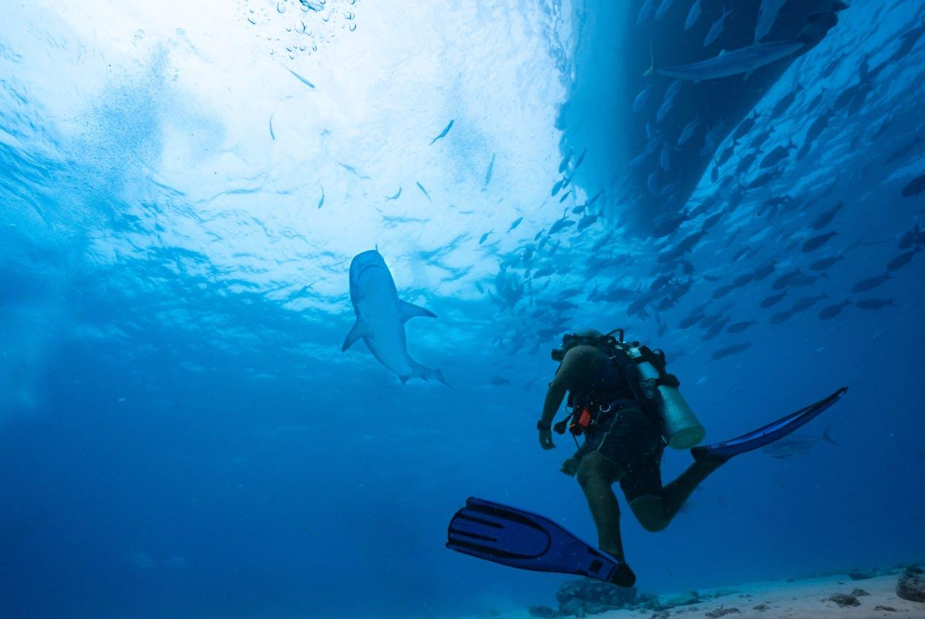
Some dive destinations feel enclosed in a comforting way. Reefs guide the eye. Coral formations create boundaries. Even in excellent visibility, there’s usually a sense of orientation — a feeling that the underwater world has edges the mind can understand.
Then there are the dives where that feeling disappears.
Not because the water is necessarily deeper, or the marine life larger, but because the environment creates an unusual sense of scale. Blue water stretches outward without obvious limits. Movement appears slowly at distance. Reef structures stop anchoring perception entirely. The ocean begins to feel emotionally larger than the diver can fully process in the moment.
Those dives stay with people differently.
Why some dives feel emotionally larger than others
Scale underwater is surprisingly psychological.
A shallow dive with strong visibility and open exposure can feel far more expansive than a deep reef framed tightly by terrain. The mind responds not only to depth, but to distance, uncertainty, and the absence of clear boundaries.
Pelagic environments intensify this effect. Divers stop focusing solely on the reef beneath them and begin scanning open water instead. Anticipation replaces observation. Attention stretches outward.
Sometimes the ocean feels biggest not when something appears — but when nothing has appeared yet.
That suspended possibility changes the emotional pace of a dive completely.
The Maldives — where movement creates openness
The Maldives remains one of the clearest examples of how movement can expand underwater space.
Channel dives rarely feel static. Current carries divers along reef edges while blue water opens beside them almost continuously. Sharks hold position in the flow. Manta rays emerge gradually from distance, suspended in water that often feels larger than the reef systems themselves.
Visibility contributes to this sensation, but current matters just as much. Divers stop moving through the environment independently and begin moving with it instead.
It’s one of the reasons diving in the Maldives often feels larger than the physical dive site alone would suggest.
The environment creates motion and scale simultaneously.
The Azores — where the Atlantic feels genuinely infinite
Few places create open-water exposure quite like the Azores.
These dives often begin with empty blue water. Offshore seamounts rise from enormous depths, but much of the emotional experience happens before anything appears at all. Divers wait. Scan. Drift slightly in the Atlantic swell while visibility fades gradually into distance.
Then something materialises — mobulas, perhaps, or blue sharks — emerging slowly enough that anticipation becomes inseparable from the encounter itself.
The scale here feels geographical as much as underwater. You’re aware not only of the dive, but of the surrounding ocean pressing outward far beyond visibility.
Galápagos — where exposure becomes part of the experience
The Galápagos Islands creates scale through intensity.
Strong current, volcanic terrain, schooling hammerheads, sudden movement through blue water — everything feels physically larger than expected. Divers often hold position against rock while open ocean dominates the edge of perception.
Hammerhead schools don’t simply appear. They emerge gradually through distance, shapes resolving slowly from movement into animals. Sea lions dart unpredictably through the water column while pelagic life moves beyond easy focus.
There’s very little sense of containment here. The ocean feels active even when visibility remains clear.
And perhaps that’s what stays with divers most strongly afterward: not a single sighting, but the persistent awareness of exposure.
Socorro — where encounters rise out of empty water
Socorro Island approaches scale differently again.
The dives often feel sparse at first. Open blue water surrounds volcanic formations without the density of tropical reefs filling every space. Divers hover. Wait. Listen to bubbles and distant movement.
Then giant manta rays appear almost silently from below or beyond visibility, altering the emotional atmosphere of the dive instantly.
What makes Socorro memorable isn’t constant action. It’s contrast. Long stretches of openness interrupted by encounters that feel enormous precisely because the surrounding water remains so empty.
Cocos Island — where the ocean feels alive beyond visibility
At Cocos Island, the ocean often feels crowded in ways divers can’t fully see.
Schools of sharks move through current beyond immediate visibility. Water movement carries suspended particles and shifting shadows that suggest activity outside direct perception. The environment feels inhabited beyond the visible frame.
Interestingly, visibility here isn’t always endless. Conditions can fluctuate considerably. And yet the scale still feels immense.
Perhaps because the diver senses movement before identifying it completely.
The water carries possibility constantly.
Iceland — where clarity alters perception
The underwater scale of Iceland comes less from marine life and more from visual distance itself.
Extraordinary visibility stretches volcanic formations outward in ways that distort normal underwater perception. Space feels unnaturally clear. Divers drift between tectonic plates while glacial water creates an almost silent atmosphere.
Without suspended particles softening the environment, distance becomes difficult to judge accurately. The underwater world feels precise, cold, and strangely enormous despite relative stillness.
This is a quieter kind of scale. Less emotional anticipation, more visual vastness.
Above the surface, many travellers continue that sense of exploration by venturing beyond Reykjavik to discover Iceland’s volcanic landscapes, glaciers, and remote coastlines. For those looking to keep costs manageable while travelling around the island, budget camper rentals in Iceland can provide a flexible way to combine transportation and accommodation during a self-drive adventure.
Egypt — where walls reshape spatial awareness
The Red Sea creates underwater scale vertically.
Wall dives remove familiar reference points quickly. Reefs fall away into blue water while visibility stretches outward alongside them. Divers stop orienting against the seabed and begin thinking in layers of depth instead.
The effect can feel surprisingly expansive even on relatively structured dives.
Clear water amplifies the sensation further. Depth becomes visible long before it becomes reachable, which subtly changes how divers perceive distance and movement underwater.
Palau — where current expands the environment
Palau feels dynamic rather than open in the traditional sense.
Current drives enormous schools of fish across reef systems while divers remain relatively stationary using hooks or positioning techniques. Instead of travelling through the reef, the reef environment moves around the diver continuously.
This creates a different kind of scale perception. The ocean feels active beyond immediate surroundings, connected through movement rather than distance alone.
French Polynesia — where openness becomes atmospheric
In French Polynesia, scale often feels calm rather than overwhelming.
Passes open into broad Pacific blue water while sharks and pelagic species move through exceptionally clear visibility. Light softens gradually into deeper blue tones instead of disappearing abruptly.
There’s space everywhere underwater here. Space between divers, between reef structures, between encounters themselves.
The result feels less dramatic than places like Galápagos or Cocos — but no less expansive.
Pelagic anticipation changes diver behaviour
One of the most interesting things about these destinations is how differently divers behave within them.
Movement slows. Attention spreads outward. Divers stop focusing solely on reef detail and begin scanning water columns, silhouettes, and distant motion instead. Conversations underwater quiet down naturally.
Anticipation becomes immersive in its own right.
And over time, many divers realise that the emotional scale of these dives often has less to do with what they saw than with what the environment made possible.
The ocean feels bigger when divers stop trying to define it
Not every expansive dive happens in deep water. Not every pelagic encounter feels enormous. Scale underwater isn’t measured cleanly by depth, visibility, or species count alone.
It emerges from openness. Exposure. Uncertainty. The feeling that the water extends beyond immediate understanding.
Some dive destinations impress through detail. Others stay with divers because, for a while, the ocean stopped feeling like a place — and started feeling endless.